
ONLINE via Microsoft Teams, 20-22 November, 2026
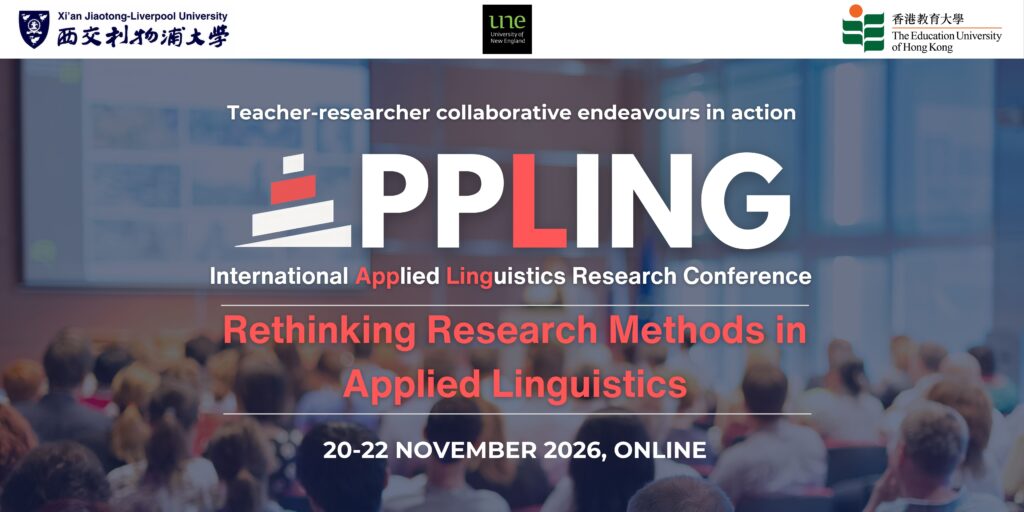
“Rethinking Research Methods in Applied Linguistics”
The 2nd Applied Linguistics Research Conference (AppLing) invites researchers, practitioners, and postgraduate students to critically examine and reimagine research methods in applied linguistics. As the field continues to evolve in response to technological innovation, interdisciplinary perspectives, and increasingly diverse contexts of inquiry, established methodological approaches are being questioned, adapted, and extended.
This conference provides a forum for reflecting on how research is designed, conducted, and evaluated, with particular attention to methodological rigour, innovation, and relevance in contemporary applied linguistics. It will be of interest to scholars seeking to refine their methodological practices, educators engaging with research-informed teaching, and postgraduate researchers developing their methodological expertise.
The 2026 conference will be delivered fully online, maximising accessibility and international participation. Digital affordances designed to support meaningful real-time interaction among participants will be a central feature of the conference experience.
Presenters will have the opportunity to publish work arising from their presentations in the conference proceedings and in a post-conference special issue of the affiliated Q1 journal The Australian Journal of Applied Linguistics (Editor-in-Chief: Professor Glenn Stockwell).
We invite submissions that address, but are not limited to, the following areas:
- Emerging and Innovative Research Methods Exploring new or underutilised methodological approaches in applied linguistics, including computational methods, multimodal analysis, arts-based research, and participatory and community-engaged methodologies.
- Revisiting Established Methodologies Critically re-examining longstanding qualitative, quantitative, and mixed methods traditions in applied linguistics, including their assumptions, limitations, and continued relevance in contemporary research contexts.
- Technology and Research Methods Investigating how digital tools, AI, corpus technologies, and online platforms are transforming data collection, analysis, and representation in applied linguistics research.
- Ethics and Researcher Positionality Examining ethical challenges and questions of researcher identity, power, and positionality in applied linguistics research, particularly in cross-cultural, multilingual, and digitally mediated contexts.
- Interdisciplinary and Cross-Methodological Dialogue Fostering conversation across disciplinary and methodological boundaries, including how applied linguistics can draw on and contribute to research methods in education, psychology, sociology, and other fields.
Abstract Submission
From this year, we are using the Edzilla submission management system. In order to use the system you will need to create an account first and then submit your abstract. You can click on the “Start Here” link to to create an account. Please note that you will need to add co-presenters after the submission has been accepted. You will need to provide a 300-word abstract for your research along with a 100-word summary of how your presentation aligns with the conference theme. Clicking the button below takes you to the submission system. You can also click on the “Portal” link from the button at the top of the page to access or edit your submission.
Presentation Formats and Review Criteria
The 2nd International Applied Linguistics Research Conference welcomes submissions in four formats: Regular Presentation, Postgraduate Presentation, Workshop, and Poster. All submissions should make a clear contribution to applied linguistics research, theory, pedagogy, or practice and must demonstrate explicit relevance to the conference theme, “Rethinking Research Methods in Applied Linguistics.”
Regular Presentations are 25 minutes long, including 20 minutes for presentation and 5 minutes for discussion, and are intended for completed or substantially developed work. Postgraduate Presentations follow the same format and are open to current Master’s and doctoral students presenting research at any stage, from proposals to completed studies. Workshops are 55-minute interactive sessions designed for hands-on engagement with tools, methods, pedagogical approaches, or research techniques. Posters are presented during a dedicated poster session and are suitable for work at any stage, including pilot studies, work-in-progress, innovative teaching approaches, and software or tool demonstrations.
Submissions will be reviewed based on relevance to the conference theme, originality and significance, clarity and organisation, scholarly or professional rigour, and the suitability of the chosen format. For workshops, reviewers will also consider the extent to which the session is genuinely interactive. For postgraduate presentations, reviewers will take into account the developmental nature of the research while still expecting clarity, relevance, and scholarly promise.
Confirmed Keynotes:

Jim McKinley
Professor, University College London, United Kingdom
Chief Editor, TESOL Quarterly; Editor-in-Chief, System
Abstract details forthcoming

Mirjam Hauck
Professor, The Open University, United Kingdom
Academic Co-Lead for AI in Learning, Teaching & Assessment, President EUROCALL
“Positionality in the Age of AI: Towards a Relational Ethics of Applied Linguistics Research”
Abstract
The field of Applied Linguistics has spent decades grappling seriously and productively with researcher reflexivity. Together, we have learned to ask who we are, where we stand, and whose knowledge we centre. However, the frameworks we have built to address these questions were designed for a different research landscape, namely one in which the researcher was the primary, identifiable agent in the production of knowledge. That landscape is changing rapidly, and I believe our frameworks must change with it. I will argue that AI-assisted research practices are not dissolving researcher positionality but displacing it. They create an illusion of methodological neutrality that actually embeds power more deeply while making it harder to name, examine, or contest it. When we use AI tools to transcribe, code, analyse, or synthesise data, we do not step outside our positionality; we extend it through systems that carry their own encoded biases, training data limitations, and linguistic hegemonies. In multilingual and cross-cultural research contexts, this displacement has particular consequences: the very diversity that Applied Linguistics is committed to promote risks being erased by tools built predominantly on and for a small fraction of the world’s languages and knowledge traditions. This risk is now acknowledged in emerging institutional guidance, but our field still lacks the methodological vocabulary to address it systematically. Moreover, what is at stake is not only the integrity of research outputs but the formation of researcher identity itself. Research, and the writing through which it is conducted, is a method of enquiry: a sustained, reflective process through which researchers develop critical awareness of their knowledge communities, their positionality within them, and their accountability to the people and contexts they study. When this process is delegated to AI systems, it is not simply being outsourced; it is interrupted. The researcher who does not work through their data, their language, and their interpretive choices is a researcher whose positionality remains unexamined and – as a result – unaccountable.
Drawing on Critical AI Literacy (CAIL) and an ubuntu-informed philosophy of inquiry – I am because of my research relationships – I will propose a relational model of positionality apt for digitally mediated research contexts. Rather than locating positionality solely in the individual researcher, this model understands it as co-constructed and made visible through dialogic, community-engaged practice. Responsible by Design, as both a pedagogical and methodological principle, is offered as a framework for enacting this relational ethics in concrete research decisions. I will conclude by inviting all of us – researchers, practitioners, and postgraduate students – to develop a richer methodological vocabulary that can hold together critical reflexivity, digital literacies, and epistemic justice in an age of increasingly automated inquiry. I believe, that this is one of the most urgent conversations our field needs to have.

Yongyan Zheng
Professor, Fudan University, China
Co-Editor, System; Editor-in-Chief, Language, Culture and Curriculum
“Transdisciplinary Turn of Applied Linguistics Research and Methodological Innovation”
Abstract
Applied linguistics is undergoing a transdisciplinary turn that requires reconfiguring its ontological, epistemological, and methodological foundations. Traditional discipline-bound paradigms are insufficient to address complex language-related phenomena, making innovative, cross-disciplinary methods essential. In this talk, I will discuss three such methods aligned with this turn: computer-assisted qualitative content analysis (CAQCA), qualitative comparative analysis (QCA), and epistemic network analysis (ENA). CAQCA uses computational tools to analyze large-scale discourse data, integrating linguistics, computer science, and data science. QCA, a set-theoretic approach, explores complex causal relationships in language learning outcomes under the guidance of equifinality, bridging qualitative depth with systematic comparison. ENA, as a representative method of quantitative ethnography, visualizes and quantifies concept connections in qualitative data, integrating psychology, network science, and sociolinguistics. These methods address the methodological demands of the transdisciplinary turn, enhancing research rigor and relevance, and are necessary for applied linguists to tackle contemporary language research challenges and foster cross-disciplinary collaboration.

Peter I. De Costa
Professor, Michigan State University, United States
Associate Editor, The Modern Language Journal; Former Co-Editor, TESOL Quarterly; Past President, American Association for Applied Linguistics
“Introducing Autoethnography in Applied Linguistics: Prospects and Possibilities”
Abstract
Beginning with an overview of ethnography and the different types of ethnography that exist in the field, I then focus on autoethnography – a methodology that is increasingly adopted by critical applied linguists who work in identity politics and are committed to decolonizing language education. After introducing several principles that underpin autoethnography, I describe how to conduct autoethnographic research. Specifically, I will draw on a range of examples from recent studies. I will also illustrate variations of autoethnography that include duoethnography and collaborative autoethnography in order to demonstrate the versatility and relevance of the processes and procedures associated with this methodology.
Important Dates:
- Opening of submissions: March 5, 2026
- Deadline for submissions:
May 31, 2026July 15, 2026 (Hong Kong Time) - Notification of outcomes: July 31, 2026
- Opening of registration: August 1, 2026
- End of early-bird registration: September 30, 2026
- Conference dates: 20-22 November, 2026
Registration Fees:
The registration fee includes full access to all live sessions throughout the three-day online conference.
Early‑bird discount rates are valid until September 30, 2026. To be eligible for the student discount rate, proof of student status may be required for verification.
Please note that all prices are in Australian dollars (AUD) and that all registration fees are non-refundable for any reason once payment has been made.
The registration fees are as follows:
Post-Conference Publication Opportunities:
Special Issue: Australian Journal of Applied Linguistics
We are pleased to announce a forthcoming special issue of the Australian Journal of Applied Linguistics associated with the 2nd International Applied Linguistics Research Conference (AppLing 2026), to be held online from 20–22 November 2026.
This special issue will provide an opportunity for selected presenters from the conference to develop their work into full journal articles for consideration in the journal. All submissions will undergo the journal’s standard double-blind peer-review process and must meet the scholarly and formatting requirements of the journal.
Please note that acceptance of a conference presentation does not guarantee acceptance for publication in the special issue. Authors should ensure that submissions align clearly with the aims and scope of the journal, as outlined below.
Aims and scope
The Australian Journal of Applied Linguistics is a peer-reviewed international open-access journal focusing on all areas of applied linguistics, including:
- naturalistic and instructed second language acquisition
- language teaching and learning
- language assessment and testing
- pragmatics and discourse studies
- multilingualism and translanguaging
- language teacher education
- educational technology, AI, and computer-assisted language learning (CALL)
- sociocultural and identity-related dimensions of language learning
- language policy and planning
- innovative research methods in applied linguistics
Submissions presenting research related to the teaching and learning of any human language are welcome from all international contexts.
Submitted articles should:
- demonstrate clear relevance to applied linguistics research and practice
- engage appropriately with relevant theoretical and empirical literature
- present methodologically rigorous and well-justified research designs
- provide clear implications for pedagogy, policy, assessment, or future research
- demonstrate scholarly originality and significance
- align with the conference theme: “Rethinking Research Methods in Applied Linguistics”
Further details regarding submission timelines and editorial procedures for the special issue will be announced following confirmation with the editorial team.
Conference Proceedings:
In addition to the special issue opportunity, authors will also be invited to submit short papers for inclusion in the official AppLing 2026 Conference Proceedings.
Proceedings submissions should present original research, methodological innovations, pedagogical insights, or practice-based contributions relevant to the conference themes. All submissions will undergo peer review to ensure scholarly quality and relevance. Accepted papers will be published in the official conference proceedings and made available digitally to delegates and the broader academic community.
Please note that submission to the conference proceedings will be separate from submission to the special issue of the Australian Journal of Applied Linguistics. Submission to the proceedings is not a prerequisite for submission to the journal special issue.
Editors:
Joshua Matthews, Glenn Stockwell, Bin Zou
Guidelines:
These proceedings will be published as a double-blind, peer-reviewed volume with an ISBN number. All manuscripts will be assigned an individual DOI and will be available as open access. This must be based on the presentation given by the author(s) at the conference held online from November 20-22, 2026.
– The paper should include a background to the study, an overview of the methodology, and representative results and a discussion of these results.
– APA 7 formatting should be used for the citations and references.
– Only include a combined maximum of two (2) figures and/or tables.
– Where available, DOIs or URLs for the references must be provided.
*Please note that you will need to register for this site. Your login details from the Conference Portal cannot be used here.
Word Limitation:
The full paper, excluding references and appendices, should not exceed 1500 words.
Important Dates:
– Submission opens: August 15, 2026
– Deadline for submission: August 31, 2026
– Reviews and notification to authors: September 30, 2026
– Submission of second draft: October 15, 2026
– Final notification of acceptance/refusal to authors: October 31, 2026
– Final publication: November 20, 2026
Submissions must be made using the link below:
https://www.castledown.com/proceedings/appling/about/submissions
Organising Committee:
Conference Co-Chairs
Glenn Stockwell &Yijen Wang
Local Organising Committee Chair
Bin Zou
Rining Wei
Programme Chair
Joshua Matthews
Edzilla Developer
Gary Ross
Administration Support
Mengshi Ceci Zhang
Wenhe Jin
Zimeng Simone Xing