
UCLouvain, Louvain-la-Neuve, Belgium, 19-21 November, 2025
“Humanity in Language Education”
Much has been spoken about the need to draw clearer relationships between the teaching and practice of language teaching, but we must always keep sight of the humans who make up the dynamics of this process, even in the midst of technological developments. The Inaugural International Applied Linguistics Research Conference seeks to explore how to deal with these issues to provide a more inclusive environment for learners of all sociocultural and socioeconomic backgrounds.
We welcome submissions that address, but are not limited to the following topics:
- Human-Centered Approaches: Investigating pedagogical strategies that center on individual learner needs, focusing on personalization, emotion, and human interaction within the language learning process.
- Translanguaging: Exploring practical and theoretical aspects of using multiple language practices in the classroom to enhance linguistic and cognitive development among diverse learners.
- Intercultural Communication: Examining methods and strategies for enhancing effective communication across different cultures to build intercultural competence in language learners.
- Multilingualism and Identity: Discussing the influences of multilingual contexts on personal and collective identity, and how these identities shape and are shaped by language learning experiences.
- Assessment and Learner-Centered Evaluation: Developing assessment methods that respect diverse learner profiles, promote fair evaluation, and support personalized learning paths in language education.
- Diversity, Equity & Inclusion: Addressing strategies to ensure that language education practices are inclusive and equitable, with a focus on acknowledging and valuing diversity across linguistic, cultural, and social lines.
- Social, Economic, and Political Issues in Language Education: Exploring the impact of broader social, economic, and political factors on language teaching and learning, and how educators can respond to these challenges in their pedagogical practices.
- Technology and Humanity in Language Education: Balancing the use of technological tools with the need for human connections in the language classroom to enhance both learning outcomes and personal interactions.
- Psychology in Language Education: Investigating how psychological principles can inform and improve language teaching strategies, focusing on areas such as motivation, anxiety, and learner behavior.
- Teacher Development and Human Relations: Discussing the role of ongoing professional development and human relations skills in enhancing teacher effectiveness and fostering positive learning environments.
- Language Education Policy and Human Rights: Examining the intersection of language education policy with human rights, focusing on advocating for equitable access and ethical practices in language teaching.
- Sustainable Language Education: Investigating strategies for implementing environmentally sustainable practices in language teaching and how these practices can support broader goals of global sustainability and educational equity.
Abstract Submission Guidelines:
- Submissions will be accepted between February 1, 2025 to March 31, 2025.
- Abstracts should be no more than 300 words including references. You will also need to explicitly address how the research presented represents a motivated transition from prior work in terms technology, practice, content, theory, and/or research methodology (maximum 200 words). .
- We welcome empirical, theoretical, and practice-oriented submissions:
- Empirical submissions should detail the research question, methodology, and key findings. This should also show a clear relationship with practice.
- Theoretical submissions should offer a brief overview of the theoretical framework and its potential implications for research and practice.
- Practice-oriented submissions should provide details of language teaching initiatives in practice, but should also provide a connection with future research.
Keynotes:

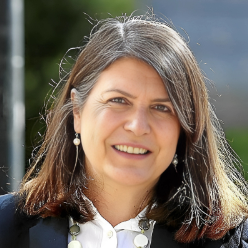
Zhu Hua
Professor, University College London, United Kingdom
Director of International Centre for Intercultural Studies, IOE – Faculty of Education and Society
Fellow of Academy of Social Sciences, UK
Chair of British Association for Applied Linguistics (2021-2024)
“Rethinking Languages in Schools: Complexity, Context and Collaboration”
Abstract
The national conversation about languages education in England is often framed as a ‘crisis’, citing declining uptake and attainment and concerns about long-term future of language learning. Yet, there are schools where languages are not just surviving but thriving. What makes the difference? This talk invites us to look beyond headlines and statistics to dive into the complexity factor shaping languages education in England. Drawing on research with over 100 secondary schools including 2 enhanced case studies, I explore how leadership vision, teacher recruitment and retention, parental engagement, pupil motivation, and accountability pressures interact to shape the reality of language learning in these schools. Using Complexity theory as a lens, we see how the same school language policy can lead to dramatically different outcome and experiences depending on a whole range of inter-related factors. But this is also a message of possibilities By recognising schools as living, complex, adaptive systems, we can move away from one-size-fits-all approaches and work together to design context-sensitive strategies that truly meet schools where they are. Collaboration between schools and with higher education institutions will be a key to building stronger, more sustainable language provision. This talk will challenge us all to rethink how we provide support for language education. By shifting the narrative from ‘crisis’ to complexity, context and collaboration, we can focus on addressing contextualised national priorities and celebrating success where language learning is flourishing.
Jasone Cenoz
Professor of Research Methods in Education, University of the Basque Country, UPV/EHU
Member of the Advisory Council of the Organization of Ibero-American States (OEI)
Past President of the Education Science Committee of the Spanish Research Council (AEI)
“Learning Minority Languages: From Isolation to Pedagogical Translanguaging”
Abstract
Minority languages such as Welsh, Basque or Frisian in Europe, Zapotec in Mexico, Hawaiian in the US, or Ashaninka in Peru and Brazil, are spoken in a specific geographical area. Their demography, status, and presence at the institutional level are weaker as compared to the majority languages they are in contact with. Learning these languages as a second language presents challenges distinct from those encountered with widely spoken languages. These challenges include legal recognition, standardization, language use, teacher education, and material development, among others. Traditionally, language learning has used pedagogical approaches based on language separation so that the target language is isolated from other languages. New trends in language acquisition and multilingualism such as translanguaging tend to soften the boundaries between languages. In this way, learners are encouraged to use their multilingual resources when learning languages. Pedagogical translanguaging can be an asset when learning minority languages, but it needs to be sustainable and allow for breathing spaces so that minority languages can be protected and developed.

Norbert Pachler
Professor of Education, University College London, United Kingdom
Vice Dean (Enterprise), IOE – Faculty of Education and Society
Fellow of Academy of Social Sciences, UK
Editor-in-Chief of The Language Learning Journal
“Language Pedagogy in an Age of AI: An Exploration of Human and Algorithmic Mediation“
Abstract
Judging by the continuing hype around AI, the ‘takeover of education’ by technologies that can perform tasks that typically used to require human intelligence is just starting. This poses significant questions about the respective roles of human and algorithmic mediation and of teacher and learner agency in the process of language teaching and learning. In this context, the question is no longer around sufficiently valorising language learning as invariably and importantly being bound up in social processes (such as collaboration, scaffolding, interpersonal interaction and negotiation of meaning), and not just mental activities (such as attention, perception, memory, internalisation, appropriation, recall); the recent focus on cognitive science and the so-called ‘science of learning’ with their undue emphasis on cognitive processes and on memory should be a stark reminder that the social dimension and contextual specificities of learning have not necessarily been sufficiently acknowledged universally. Instead, the questions of outsourcing of thinking as well as knowledge production and knowledge work to ‘the machine’ come to the fore as does the question of what it means to be human. In educational terms, AI threatens to accelerate the upending of (has upended?) the traditional academic model in which knowledge flows from expert to novice. This keynote will seek to problematise and explore implications of the role of AI in terms of human and algorithmic mediation.
Important Dates:
- Opening of submissions: February 1, 2025
- Deadline for submissions: May 15, 2025
- Notification of outcomes: May 31, 2025
- Opening of registration: June 15, 2025
- End of early-bird registration: July 30, 2025
- Deadline for submission of proceedings papers: July 30, 2025
- Conference dates: November 19-21, 2025
Program Overview:
| November 19 (Wednesday) | 14:00-15:00 Registration 15:00-16:00 Workshop on Publishing in High IF Journals 16:00-17:30 Conference Workshops |
| November 20 (Thursday) | 08:30-09:00 Registration 09:00-09:30 Opening Ceremony 09:30-10:30 Keynote 1 (Zhu Hua) 10:30-10:45 Morning Tea 10:45-12:10 Parallel Sessions 12:10-13:15 Lunch 13:15-14:40 Parallel Sessions 14:45-15:00 Afternoon Tea 15:00-16:00 Keynote 2 (Jasone Cenoz) 16:05-17:30 Parallel Sessions 19:00-21:00 Conference Dinner |
| November 21 (Friday) | 09:00-10:00 Keynote 3 (Norbert Pachler) 10:05-10:30 Poster Sessions 10:30-10:45 Morning Tea 10:45-12:10 Parallel Sessions 12:10-13:15 Lunch 13:15-14:40 Parallel Sessions 14:40-15:00 Afternoon Tea 15:00-15:55 Closing Panel 16:00-16:30 Closing Ceremony and Award Announcements |
You may download the conference schedule in PDF format from here. Please note that it may not reflect the latest changes, so please check the boards posted at the conference venue for the latest schedule. You may also view the conference schedule at https://appling-research.org/schedule/?event=appling2025. The schedule below was last updated on November 21, 2025 at 11:15 am.
Conference Registration:
The registration fee includes participation in the conference for all three days of the conference, all conference workshops, all morning tea and afternoon tea sessions, and lunches on November 19 & 20. It also includes the conference dinner on November 19 where you can interact with the other participants and the keynote speakers. Participants can register for the Conference Dinner (November 19) separately (if your institution does not allow this to be included) and/or for your partner/guest(s). Please note that all prices are in Australian dollars (AUD).
Earlybird discount rates are valid until July 30, 2025. Validation of student status may be required to be eligible for the Student Discount Rate.
The registration fees are as follows. Amounts in euros are intended as an approximation only:
| Registration Type | Package | Approx €* |
|---|---|---|
| Earlybird Student Participant | A$390 | 220€ |
| Earlybird Regular Participant | A$495 | 280€ |
| Student Participant | A$455 | 255€ |
| Regular Participant | A$570 | 320€ |
| Conference Dinner Only | A$115 | 65€ |
*Please note that fees are charged in AUD, and the euro value is intended only as a guide.
Conference Venue:
The conference will be held at the UCLouvain in Louvain-la-Neuve, situated around 30km southeast of Brussels, the capital of Belgium. The location provides easy access to many other fascinating areas in Belgium by train, such as Ghent and Bruges.
Getting to UCLouvain
- For delegates travelling within Belgium and nearby countries: UCLouvain is easily accessible by train. The nearest station is Louvain-la-Neuve Université, located right in the city centre and just a short walk from the campus. Regular trains connect Louvain-la-Neuve with Brussels and other Belgian cities.
- For international delegates: The closest airport is Brussels Airport (Zaventem). From the airport, you can take a direct train to Louvain-la-Neuve with one easy connection at Brussels (approx. 1 hour total travel). Alternatively, Brussels South Airport (Charleroi) also offers access, with shuttle buses and train connections to Louvain-la-Neuve.
Local Organising Committee:
Fanny Meunier, UCLouvain
Ferran Suner Munoz, UCLouvain
Serge Bibauw, UCLouvain
Remy Decorte, UCLouvain
Germain Simons, ULiège
Conference Proceedings:
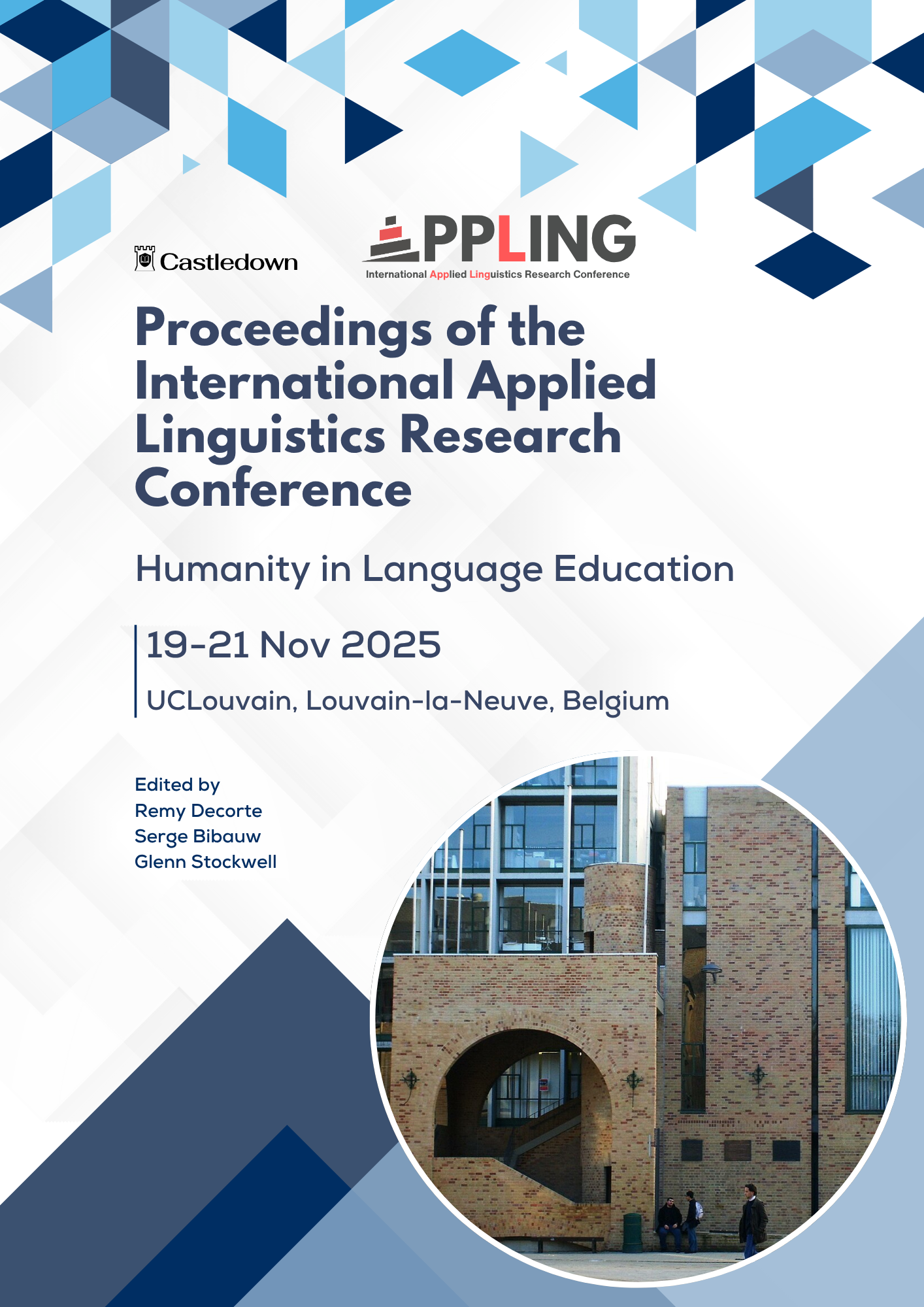
Editors: Remy Decorte, Serge Bibauw, Glenn Stockwell
You may see the PDF below or download the proceedings from here.
The individual papers in the proceedings will be available shortly from: https://www.castledown.com/proceedings/appling/
Post-Conference Special Issue:
A post-conference special issue on the conference theme is planned to appear in the Australian Journal of Applied Linguistics (Scopus Q2) in mid-2026. Abstract submissions are due by December 15, 2025.
Guest Editors: Fanny Meunier & Ferran Suner Munoz
More information about the special issue is available from here: https://www.castledown.com/journals/ajal/announcement/view/11
Please subscribe for further information about this or upcoming conferences. Information will also be posted on social media, but subscribing will ensure you do not accidentally miss out on important information about the conference.